
Virtual receptionist for small business: Boost Productivity and Grow Your Leads
Discover how a virtual receptionist for small business can cut costs, capture every lead, and deliver 24/7 professional service.A virtual receptionist for small business is essentially your front desk, operating remotely. It can be a real person or sophisticated AI, but the goal is the same: to handle your incoming calls so you don't have to. It's the modern, smarter way to ensure you never miss a customer and always sound professional, without the cost of a full-time hire.
What Is a Virtual Receptionist and Why Your Business Needs One
If you're a small business owner, you know the sound of a ringing phone is a mix of opportunity and interruption. That call could be your next big client, but answering it pulls you away from the work that actually makes you money. Every call that goes to voicemail is a potential lost lead.
But hiring a full-time, in-house receptionist can easily cost over $45,000 a year when you factor in salary and benefits. That’s a tough pill to swallow for most growing businesses.
This is exactly where a virtual receptionist comes in. It’s your gatekeeper, your appointment scheduler, and the friendly first voice your customers hear—all without the overhead of another employee. Think of it less like a simple answering service and more like a remote extension of your team.
The Three Core Types of Virtual Receptionists
Virtual receptionists aren't a one-size-fits-all solution. The services are broken down into a few key models, each built for different business needs and budgets.
Here's a quick visual of the main options you'll come across:
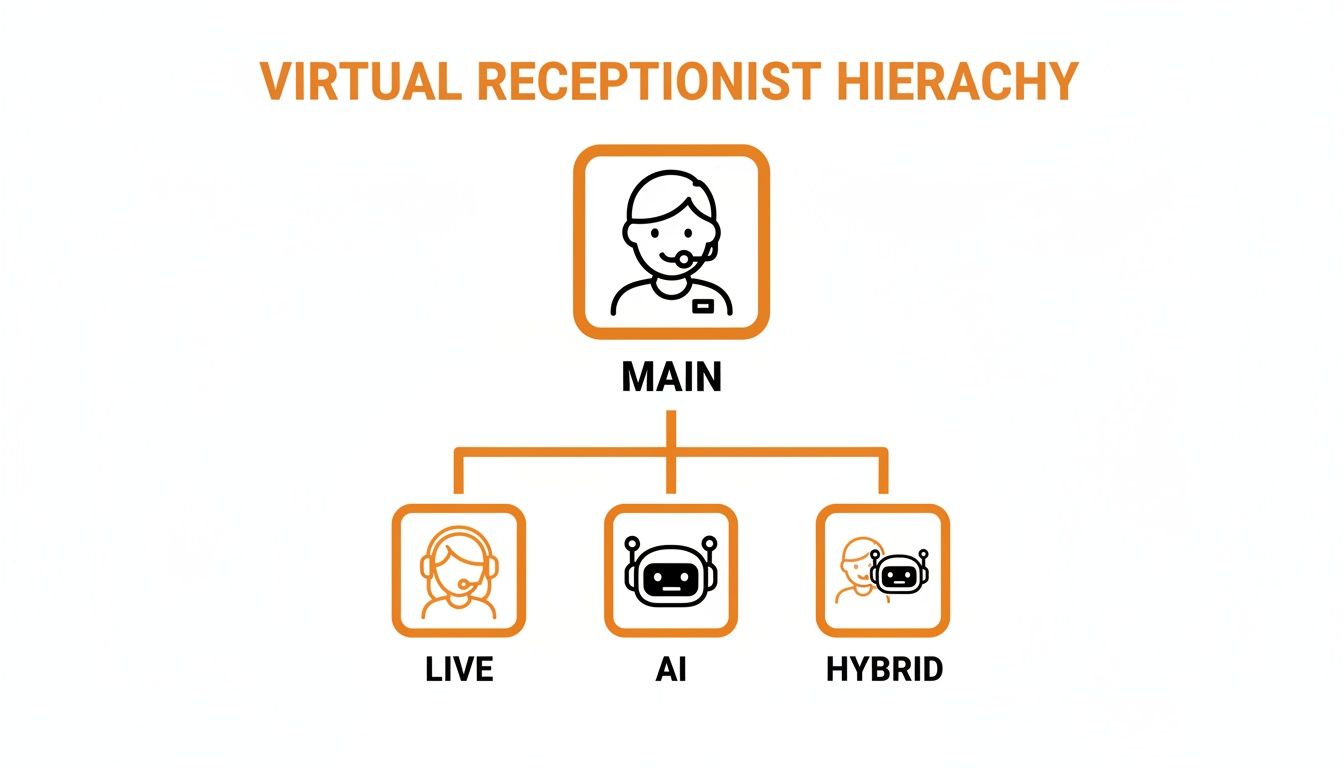
As you can see, your choice boils down to a live human agent, a fully automated AI system, or a hybrid model that blends the best of both worlds. The adoption of these services has skyrocketed recently, and for good reason.
Recent reports show that 68% of small businesses now use some form of AI to engage with customers. With AI receptionists achieving roughly 80% positive customer experience rates and 51% of customers saying they prefer an instant AI response for initial contact, the move toward 24/7 service is undeniable. You can dive deeper into the data on AI receptionist adoption to see just how common this has become.
Key Takeaway: A virtual receptionist isn't just about answering the phone. It's a strategic tool for managing customer interactions, capturing every lead, and growing your business without bloating your payroll.
To help you decide which path is right for you, here’s a simple breakdown of the main types.
At-a-Glance Virtual Receptionist Options
| Receptionist Type | How It Works | Best For |
|---|---|---|
| Live Receptionist | A real person answers calls on your behalf from a remote location. | Businesses needing a personal, high-touch experience for complex inquiries, like law firms or medical clinics. |
| AI Receptionist | An automated system uses voice AI to answer calls, book appointments, and answer common questions. | Businesses looking for 24/7 coverage and cost-effective handling of high-volume, repetitive calls. |
| Hybrid Model | Combines AI for initial triage and after-hours support with live agents for complex or escalated calls. | Companies wanting the efficiency and availability of AI but with a human safety net for important conversations. |
Whether you need the empathetic touch of a human for detailed client intake or a tireless AI to book appointments while you sleep, there’s a solution out there. This flexibility is what allows small businesses to finally compete with larger companies by offering exceptional, round-the-clock service.
What Can a Virtual Receptionist Really Do for Your Small Business?
Bringing a virtual receptionist on board isn't just about having someone to answer the phone. It's a strategic move that fundamentally changes how your business operates, making you look more professional and directly boosting your bottom line. It's about shifting from being reactive to being proactive, turning every single phone call into a real opportunity.

The first thing you'll notice is how much more professional your business sounds. When a new client calls, you have only a few seconds to make a great first impression. A fast, friendly, and professional answer immediately builds trust and makes your small company feel as solid and reliable as a big corporation.
Get Your Time Back and Get More Done
Let's be honest: the phone ringing off the hook can kill productivity. It’s a huge distraction. Think about lawyers who spend nearly half their day buried in administrative tasks instead of working on cases they can actually bill for. This isn't just a problem for law firms—it’s a reality for any small business owner trying to do it all.
A virtual receptionist acts as your gatekeeper. They handle all the routine questions and only pass along the calls that genuinely need your attention. This one change lets you and your team concentrate on the important stuff without constant interruptions. You’ll be surprised how much more you can get done.
The Big Idea: A virtual receptionist doesn't just answer calls; they manage interruptions. By handing off this crucial task, you free up your team to focus on the work that actually grows the business.
Stop Missing Calls and Start Making More Money
Every call that goes to voicemail is a potential customer lost. Most people won't bother leaving a message; they'll just hang up and call the next person on their list. This is especially true after 5 PM or during a hectic lunch hour when nobody's at their desk.
A virtual receptionist gives you 24/7 coverage, making sure every single lead is captured, no matter when they call.
Just imagine these situations:
- A motivated buyer finds your real estate listing at 8 PM on a Friday. Instead of getting your voicemail, a receptionist takes down their info and books a showing for Saturday.
- A potential client needs urgent legal advice after hours. The service gathers all their details, locking in a high-value consultation for the next morning.
This kind of round-the-clock availability transforms your phone into a lead-generating machine. Many companies are already learning how powerful automated follow-up can be, and it’s worth exploring how chatbot lead generation can work alongside a human touch. By capturing details and scheduling appointments automatically, you can be sure no potential customer ever slips away.
See How Different Industries Win with Virtual Receptionists
Theory is one thing, but seeing how a virtual receptionist works in the real world is where it all clicks. Let's move past the abstract and look at how actual small businesses are using this service to solve real, industry-specific headaches.
Law Firms: Turning Chaos into Billable Hours
Picture a busy law office. It’s a well-known secret that lawyers can lose almost half their day to administrative tasks instead of focusing on billable work. This is where a virtual receptionist becomes the firm's first line of defense.
They act as an expert gatekeeper, fielding every incoming call. Is it a potential new client? An opposing counsel? A question about an existing case? The receptionist screens and routes each one appropriately, ensuring attorneys and paralegals are only pulled away for things that truly need their attention.
They can handle the initial client intake, schedule consultations right on the lawyer's calendar, and make sure all the critical details are captured from the get-go. What was once a chaotic mess of ringing phones becomes a streamlined system for bringing in new clients. It's a true game-changer for legal practices. For a deeper dive, check out our guide on the virtual receptionist for law firms.
Real Estate: Never Let a Hot Lead Go Cold
Now, let's switch gears to a real estate agency. In real estate, speed is everything. A potential buyer who drives by a "For Sale" sign at 7 PM on a Friday isn't going to wait around until Monday morning. If their call goes to voicemail, they're already dialing the next agent on their list.
A 24/7 virtual receptionist plugs this leaky bucket immediately.
- Capture Every Call: The receptionist answers live, grabbing the caller's name, number, and the specific property they’re curious about.
- Book Showings Instantly: It can then sync with the agent’s calendar to schedule a showing on the spot, sending a confirmation to both the agent and the buyer.
- Qualify on the Fly: The service can even ask a few smart questions, like, "Are you already working with an agent?" or "Have you been pre-approved for a mortgage?"
This simple setup means every single lead—whether from a yard sign, a Zillow ad, or a referral—is captured and engaged right away. It massively boosts an agent's odds of closing the deal.
Healthcare and Travel: More Focus, Less Friction
This isn't just for lawyers and real estate agents. Medical and wellness clinics use HIPAA-compliant virtual receptionists to handle the flood of calls for appointments, rescheduling, and prescription refills. This frees up the front-office staff to focus entirely on the patients standing right in front of them, creating a much better in-person experience.
A doctor's office can slash patient wait times and cut down on admin mistakes by automating routine phone tasks. At the same time, a travel agency can instantly answer common questions about destinations or booking policies, letting their agents focus on crafting those complex, high-ticket itineraries for clients.
In every case, the virtual receptionist is so much more than a simple answering service. It’s a strategic part of the business workflow. It takes over the repetitive, time-sucking tasks, which lets the skilled professionals do what they do best: generate revenue and build lasting relationships with their clients. That’s what makes it such a powerful tool for any small business.
How to Set Up Your Virtual Receptionist System
Getting a virtual receptionist up and running is surprisingly straightforward. You don't need to be an IT wizard; these services are built for busy entrepreneurs who need a solution that just works. The whole point is to get you set up fast so you can get back to what you do best.

The first thing you’ll do is simply forward your existing business phone number to the service. It’s a seamless handoff that happens behind the scenes. Your customers will never know the difference—they dial the same number they always have, and your new receptionist picks up. Zero disruption, zero confusion.
Designing Your Perfect Call Flow
Now for the fun part: mapping out your call flow. This is just a fancy term for creating a simple playbook that tells your receptionist exactly how to handle different types of calls.
Think of it like giving instructions to an in-house employee. Your call flow might look something like this:
- When a new lead calls: Gather their name, number, and email. Answer a few basic questions and book them straight into your calendar for a consultation.
- When an existing client calls: Find out what they need and transfer them directly to the right person on your team. No more bouncing people around.
- If it's an emergency: Send an immediate text message to your phone with all the details.
- For common questions: Give a standard, pre-approved answer about your business hours or address.
Setting this up from the get-go means every single caller gets the right response, fast.
Integrating with Your Existing Tools
This is where a virtual receptionist goes from being just an answering service to a core part of your business. A good system should plug right into the software you already use every day, like your CRM and calendars.
When you connect your calendar, for instance, your receptionist can see your real-time availability and book appointments for you on the spot. That new meeting instantly pops up on your schedule, and the client’s info gets logged automatically in your CRM. This automation is a huge time-saver and kills the need for manual data entry.
By connecting your core tools, the virtual receptionist becomes more than an answering service; it becomes an active part of your sales and operations engine, capturing leads and managing schedules without you lifting a finger.
Customizing the Voice and Experience
To really make this work, the experience has to feel authentic to your brand. After all, this is your new front line. Top-tier providers give you a ton of control over how your receptionist sounds and interacts with callers.
Here’s what you can usually customize:
- Custom Greetings: You get to write the exact script for how every call is answered.
- Brand Voice: Do you want to sound friendly and casual? Or more formal and professional? You decide.
- Voice Cloning: Some advanced AI services can even clone your own voice, which offers an incredibly personal touch.
The end goal is an interaction so smooth that your callers assume they're talking to someone right there in your office. This level of detail makes all the difference. To see how this comes to life in a real-world setting, take a look at this virtual receptionist demo for a dental office, where a professional and reassuring tone is critical.
And, of course, if you're in a field like healthcare, making sure your service is HIPAA-compliant is an absolute must to protect client privacy.
Analyzing The Costs And Calculating Your ROI
For any small business, every dollar counts. So when you're thinking about new services, the big question is always: "Is it worth it?" Let's break down the real numbers behind a virtual receptionist, because the financial argument is often surprisingly strong.
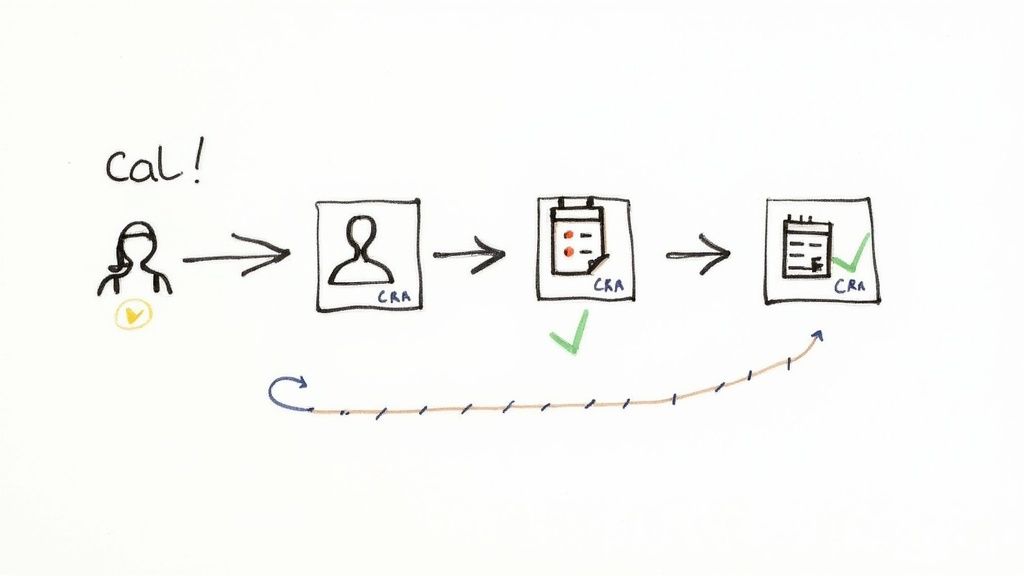
It’s easy to start with a simple comparison. When you hire a full-time receptionist, you’re paying for more than just their salary. You have to factor in benefits, payroll taxes, vacation time, sick days, and even the cost of a desk and a computer. Add it all up, and the true cost gets pretty high, fast.
A virtual receptionist, on the other hand, usually comes with a clear, predictable monthly fee. The savings are immediate and can be massive. For a lot of small businesses, this simple math makes the decision a whole lot easier.
The True Cost Of An In-House Employee
Let’s be honest about the real expenses of a traditional receptionist. These costs often fly under the radar but can put a serious dent in your budget.
- Salary & Benefits: This is the big one, but it's just the starting point.
- Payroll Taxes: Don't forget Social Security, Medicare, and unemployment taxes.
- Overhead Costs: You're paying for office space, a computer, a phone line, and supplies.
- Paid Time Off: You're still paying even when they're on vacation or out sick.
- Training Time: It takes time and money to get a new hire up to speed.
When you lay it all out, the financial edge of a virtual service becomes crystal clear. Data shows the "fully loaded" cost of an in-house receptionist can run anywhere from $3,000 to $4,500 per month.
In contrast, live virtual receptionist services typically range from $300 to $1,000 a month. And if you go with an AI-powered option? You could be looking at as little as $50 to $200 monthly. For more details on these numbers, you can find some great virtual receptionist service provider statistics.
To put this in perspective, here's how the annual costs stack up.
Annual Cost Comparison: In-House vs. Virtual Receptionist
This table shows the potential annual savings for a small business choosing a virtual receptionist over a traditional employee.
| Expense Type | In-House Receptionist (Annual) | Live Virtual Receptionist (Annual) | AI Virtual Receptionist (Annual) |
|---|---|---|---|
| Salary/Service Fee | $38,000 | $7,200 | $1,200 |
| Benefits & Payroll Taxes | $11,400 | $0 | $0 |
| Overhead & Equipment | $2,500 | $0 | $0 |
| Training & Onboarding | $1,500 | $0 | $0 |
| Total Annual Cost | $53,400 | $7,200 | $1,200 |
Note: Figures are estimates and can vary based on location, service provider, and specific business needs.
The numbers speak for themselves. The direct savings are significant, freeing up crucial capital that you can reinvest back into growing your business.
Calculating Your Return On Investment
But the real ROI isn't just about saving money—it's about making money. The true value comes from the new business you capture because your phone is always answered professionally.
Key Insight: Your ROI isn't just about cutting a salary. It's about the new revenue you gain from opportunities that were previously falling through the cracks.
Think about the lifetime value of just one new client. If your virtual receptionist snags one or two solid leads a month that you otherwise would have missed, the service can easily pay for itself many times over.
Suddenly, it's not just an operational expense anymore. It’s a powerful tool for generating revenue.
How to Choose the Right Service for Your Needs
<iframe width="100%" style="aspect-ratio: 16 / 9;" src="https://www.youtube.com/embed/CUB3R5a8c2U" frameborder="0" allow="autoplay; encrypted-media" allowfullscreen></iframe>Trying to find the right virtual receptionist for your business can feel a little overwhelming. The market is packed with options, and it's growing fast—it's expected to hit nearly $1.85 billion by 2025.
More choices are great, but it also means you have to be smart about what you're looking for. You can learn more about the growth of the virtual receptionist market to see just how much this space is expanding.
The best way to start is by taking a hard look at your actual needs. How many calls does your business handle on a typical day? Are they quick, simple questions, or do they often involve more detailed problem-solving? Knowing this will help you figure out if a live agent, a smart AI, or maybe a mix of both is the right fit.
Key Factors for Your Decision
Once you know what you need, it's time to match those needs with your budget and the tools you already use. Finding the sweet spot between cost and the features you can't live without is the name of the game.
Here are the three big things to consider:
-
Budget: First, figure out what you can realistically spend each month. Some services charge by the minute, while others offer a flat monthly fee. Know your numbers before you start shopping.
-
Integrations: Can the service talk to your other software? If it can't connect with your CRM or automatically book appointments on your calendar, you'll be stuck doing a lot of manual work. Smooth integration is a huge time-saver.
-
Trial Periods: Never commit without a test drive. A free trial is the best way to see if the receptionist's voice and style actually fit your brand. It’s your chance to experience the service firsthand before you sign on the dotted line.
Got Questions? Let's Clear Things Up.
Even after seeing all the ways a virtual receptionist can help, it's completely normal to have a few lingering questions. It's a big step for your business, after all. Let's tackle some of the most common concerns we hear from entrepreneurs just like you.
"Will my customers know they're not talking to someone in my office?"
This is probably the number one question we get, and the answer is a resounding "no." Modern virtual receptionists, whether they're live agents or sophisticated AI, are designed to feel like a natural part of your team.
The best services don't offer a one-size-fits-all solution. You get to build custom scripts and define the exact tone and personality that fits your brand. Think of it less as an answering service and more as an extension of your own company culture, ensuring every caller has a warm, professional experience.
"I'm not a tech wizard. Is this going to be hard to set up?"
You'll be happy to hear you don't need to be. These platforms are built specifically for busy business owners who don't have time for a complicated technical setup. Most of the process is guided, intuitive, and backed by a real support team.
From forwarding your existing phone number to creating your first call script, they walk you through it. Honestly, you can be up and running in less than an hour, with zero special tech skills needed.
"What happens if a really complicated or urgent call comes in?"
That’s a great question, and you're completely in control here. When you set up your service, you'll create what are called "escalation protocols." It sounds technical, but it’s just a simple set of rules for what to do when a call needs special attention.
You decide which calls your receptionist handles and which ones need to be sent straight to you or a team member. For those complex or urgent issues, the call can be instantly transferred, a detailed message can be taken for immediate follow-up, or you can get a priority alert via email or SMS.
This system gives you the best of both worlds: your receptionist filters out the routine stuff, while you're guaranteed to get the critical calls without delay. It’s all about giving you peace of mind.
Ready to see how a 24/7 AI receptionist can transform your business? CallCow handles your calls, books appointments, and captures every lead, so you can focus on growth. Try CallCow for free and set up your perfect call flow in minutes.